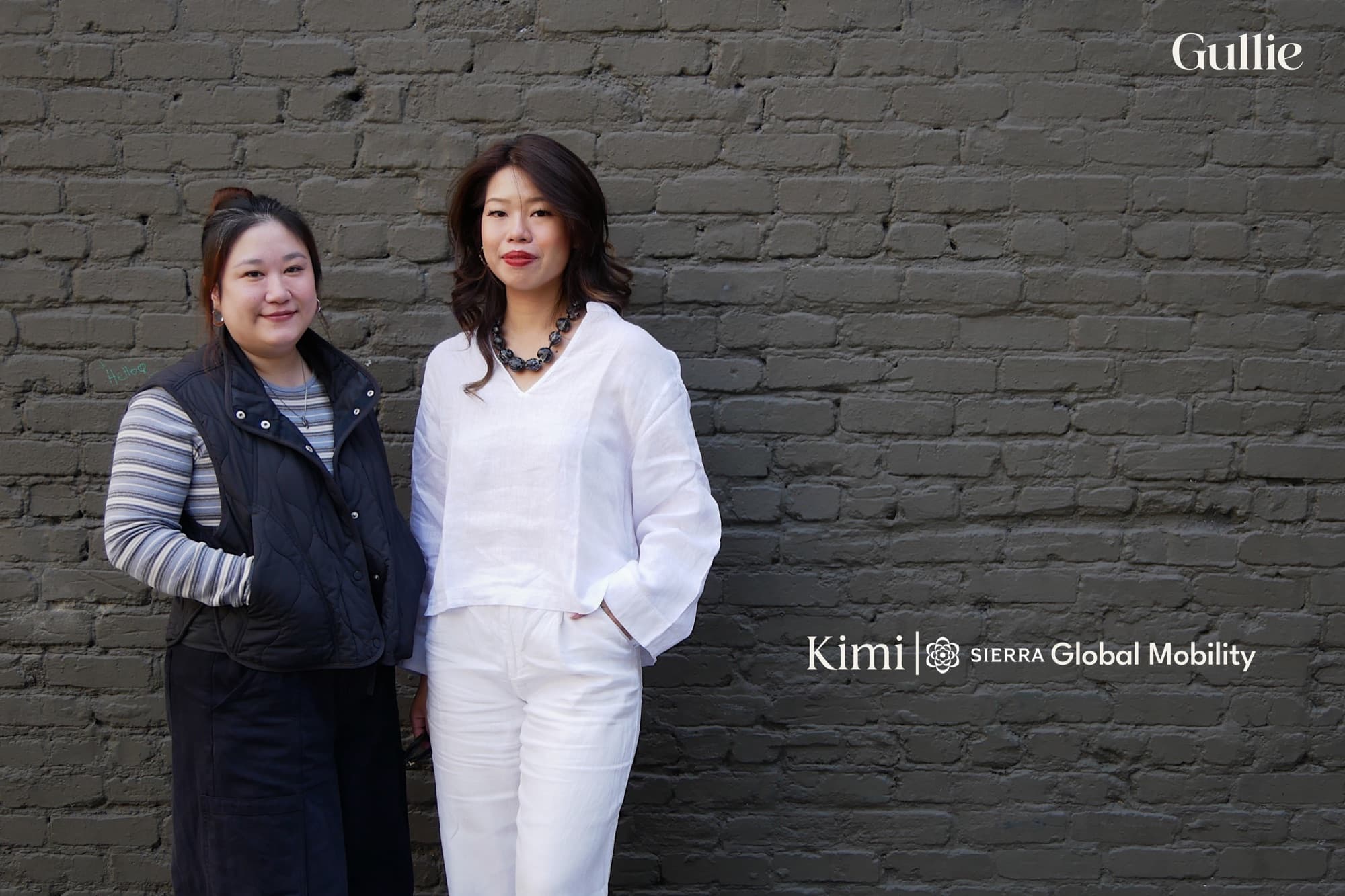
Mobility product leaders

In conversation with Kimi

Teaching herself to build the tools mobility has been missing.

📍 filmed in san francisco

Kimi Su, Sierra Global Mobility, Gullie Mobility Product Community

“I was holding somebody's achievements and ambitions in my hands. It was an honor to take good care of that.”

Kimi Su, Sierra

About

Kimi is Global Mobility Manager at Sierra, where she was HR team member number five and runs the full stack of the work: immigration, mobility tax, and relocation. Her path there began at Fragomen, the immigration law firm where she was told to temp until she figured out what she wanted, and stayed almost three years. Then a startup, where she started as a paralegal and moved into global mobility and compliance, and four-plus years running Americas' talent mobility at Electronic Arts before joining Sierra at the start of 2026.

She may also be the least mobile person in global mobility, and she'll tell you so herself. Born in the US, she spent her early childhood in Taiwan and has called the San Francisco Bay Area home ever since. Before any of this she studied evolutionary anthropology at UC Davis and worked with primates. A self-described introvert, she now spends her spare cycles teaching herself to build small AI agents for the admin work she knows too well.

Based in
San Francisco Bay Area
Hometown
Born in the US, raised in Taiwan, and in the Bay Area since she was six
Dream city
Tokyo
Hobbies
Gaming, reading, and planning her next vacation
Behind the scenes

Kimi Su calls herself “the least mobile global mobility person ever,” and she means it as a fact about geography, not ambition. Born in the US, raised in Taiwan until six, in the Bay Area ever since, she now runs the full stack of immigration, mobility tax, and relocation at Sierra. She got here “by accident, and then on purpose.”

She was working with primates in animal welfare when her brother-in-law’s aunt offered her a temp job at an immigration law firm “with strict instructions not to stay.” “I made a career out of it instead.”

The paperwork could have stayed paperwork. It didn’t. “I came to realize I was holding somebody’s achievements and their ambitions in my hands, and that it was an honor and a responsibility to take good care of that.” She knows how that sounds. “It’s a romanticized way of looking at pushing paper, but there was a real person behind every petition, hoping I’d do a good job on their behalf.” That feeling, she says, “never left, and it carried me from immigration into mobility as a whole.”

01

Where a move actually breaks

Ask Kimi where relocations go wrong and she skips the horror stories for one word. “Alignment.”

“What are the expectations of the business? What are the expectations and the needs of the employee? How informed and aligned are all of your providers in getting this relocation through, meeting the business’s needs while supporting the employee?” The failure mode is narrower than it looks. “Where it fails is when someone has expectations and the experience doesn’t deliver against them.” So the job, as she defines it, is “making sure everyone who needs to be involved is aligned every step of the way, and that everyone’s expectations are realistic.”

02

Building the tools she wished she had

Kimi is not an engineer, which is exactly why this part of her story matters. She has started teaching herself to build small AI agents around the repetitive parts of mobility work. “Before, if the workload kept growing, my instinct was, ‘Okay, do we need another headcount?’ Now my instinct is, ‘Could an agent do this?’” The point isn’t cutting people. “Not because I’m trying to replace people, but because so much of the work we do is administrative. If I can automate that, it frees me and my team up to spend our time on the strategic work and the human conversations that actually matter.”

It is how she approaches her own job now. “Anytime I find myself doing something repetitive, I ask, ‘Should I keep doing this, or should I build an agent?’” The work she is comfortable talking about publicly is intentionally practical: taking admin off her plate, flagging what needs a human look, and giving her more time to partner with the business and support employees. The guardrails come first. “Obviously, in HR you have to be incredibly careful. We work with sensitive employee information, so privacy and security come first.”

That restraint is what makes the story more interesting, not less. She is not pitching a grand theory of AI replacing mobility. She is doing the operator version: find the boring thing that steals time, build a small tool around it, and use the time you get back for the conversations a model should not be having.

03

The part an agent should never touch

For all of that, Kimi draws a hard line. “This role is human first and it should remain that way. AI is never going to replace the phone call you make to an anxious new hire.”

The human work isn’t only the emotional part. It’s also “sitting down with business leaders and hiring teams, understanding what they’re actually trying to accomplish, and giving them practical recommendations for how to get there.” They could ask a model. “They’re not going to get the tried-and-true answer they’d get from an in-house expert who knows the company.”

04

Watching someone build something real

For all the process, the part Kimi keeps coming back to is the person. “The piece we own can be extremely important: the founding team member you’re sending into a new country to build. That’s super meaningful.”

And she gets to watch what happens next. “We send someone abroad, they build something real, and when they come back, they come back into a leadership position because of the work they did out there.” When people press her on the ROI of mobility, that is where she points. “In a growing company, the ROI is straight business opportunity combined with personal growth for that individual.”

05

Why she’s betting on it

Kimi hears a lot of AI pitches; Gullie landed differently. “What got me was that Gullie was really turning relocation on its head and going AI first. I had just never heard of that.”

Her conviction is that the bet matches the people she moves. “If someone’s job is building AI agents, an AI-first relocation experience gives them the right picture of their new company from the very first touchpoint.” She puts the point plainly. “Onboarding starts before day one. It starts with the move.”

More from the conversation

Question 01

Why mobility?

I fell into it, honestly. I'd been working in animal welfare after studying evolutionary anthropology, and I wasn't sure what I wanted to do next. My brother-in-law's aunt was a partner at Fragomen and said, come temp at my law firm until you figure it out, but make sure you don't stay. I stayed. In the beginning, working with immigration petitions was like learning a new language. But I came to realize I was holding somebody's achievements and their ambitions in my hands, and that it was an honor and a responsibility to take good care of that. It's a romanticized way of looking at pushing paper, but there was a real person behind every petition, hoping I'd do a good job on their behalf. It could be life-changing for them. That feeling never left, and it carried me from immigration into mobility as a whole.

Question 02

You call yourself an introvert, in one of the most people-facing jobs in HR. How do those fit together?

I'm an introvert, but I love to help people, and this is my little slice of finding meaning: getting someone through something hard. The other thing I love is that mobility is a super niche role that touches everything in the employee lifecycle. Payroll, employment law, corporate tax. We have to be experts in immigration, mobility tax, and relocation, but the job sits at the intersection of all these other processes. I'm not just a cog. I have to know how the whole thing works.

Question 03

You were HR team member number five, and your job was mobility. When should founders actually take this seriously?

My advice to founders: the moment you bring in any employee who's on a visa, make sure you have the right immigration partner. If you're moving someone, bring in the expertise that makes it an excellent experience. You don't necessarily need someone in-house early. But you do need to start building that infrastructure of support around you early.

Question 04

You've gone from a startup, to a company with a policy for everything, back to a startup with none. Do startups actually need a relocation policy?

I think about this a lot, because I've lived the whole spectrum. I'm not a believer that everything needs to be a policy, and I'm not a believer that everything needs to be globally consistent. It's really important to keep local context and build locally, because otherwise you're building everything through HQ's lens, and that doesn't fit around the world. And if you have a really high talent bar and a really good culture, you don't need policies right away. You need guidelines, and most importantly you need trust. If you've hired people you can truly trust, especially your first teams, you don't need policies. You need practical conversations about what people actually need.

Question 05

Startup mobility teams seem to trust AI-native vendors. Enterprise teams hesitate. How does a bigger program get comfortable?

Get comfortable with AI yourself first. Use it, find creative ways to build it into your process. Doing that is what builds trust in the products, because you understand what it can and can't do. AI is not one hundred percent foolproof, and that's exactly where the human expertise comes through. But where you can simplify, you should. And then when you're looking at providers who use AI, you're evaluating them from experience instead of fear. You don't have to blow up everything you already have. Bring in something new as a pilot, try it for your program, and see if it adds value.

Question 06

What do you wish your own providers understood about this moment?

I don't need a provider to pretend they have the whole AI roadmap figured out. I want them to be curious enough to build with their customers. Show me something new. Ask where the workflow is painful. Let the people doing the work shape the product. The tools that will matter are the ones built through that kind of back-and-forth.